By Katie May Tucker, Dr. Wayne R. Tucker
original published date: 5/6/2023
KEY TERMS:
Cypher, Linguistics, Galwegian, Lancaster, Tudor, John of Gaunt, King Henry V, Old English Law Hand, Military Code, Nautical Merchant Argot Language, Kingdom of England, Kingdom of Ireland, Kingdom of Scotland.
ABSTRACT:
The cultural significance of researching the House of Lancaster’s hidden military codes redefines how a small little country in the North could become a world Empire. In analyzing Yale MS 408 and understanding the cypher and who created it, it uncovers a lot of political dynamics within Europe during the Middle Ages. This study used cryptography of perceptual dialectology through etymology by analyzing the entire European Royal Families Blood line. The result was an astonishing uncrackable code still relevant to today’s standards used to hide Royal, Catholic and Templar Secrets. Yale MS 408 is the calling card of House Lancaster because of evidence found within the royal families signatures that are the only known symbols to match 100% in the manuscript.
BACKGROUND:
While researching Yale MS 408 our team came to the conclusion that no known published work on the manuscript is accurate. In our published paper “Using Astronomy Calculations to Determine Location and Date in Medieval Ciphered Documents” it was revealed that the location of MS 408 was Kirkcudbright Bay Scotland, in the heartland of the McLellan Clan, whom where members of the Tudor Royal Court. This led to uncovering that House Lancaster produced MS 408, the discovery phase of the research pinpointed a particular signature style used throughout the bloodline that was only used in the manuscript’s cypher. Because of this our background is brief, previous and current information surrounding the manuscript is all inexact. For the exception of material and ink tests carbon dating the manuscript between 1405-1425. The relevance of MS 408 code is not the code itself but the group of individuals that created it and the decedents that used it to build an Empire.
PURPOSE OF YALE MS 408
MS 408 is not a manuscript, it is a military legal Admirals field manuel with the following: the first known world Atlas, Navigator instructions, Oceanography, Meteorology, Maritime Law, and Surveying device instructions. The cipher in MS 408 is the purpose and meaning of the entire document, it is composed of an entire families knowledge past down to descendants saved in private royal libraries.
The origin of information found in MS 408 is reminiscent of a 5th BCE Greek document called The Periplus of Hanno the Navigator. Periplus voyages contain navigational charts to Africa identical to what our team calculated in MS 408. Hanno the Navigator was scribed by Pliny the Elder as being capable of circumnavigating the continent of Africa. Hanno was a member of the family Magonids, whom lived in a region near Phoenician colonies. In MS408 Phoenician math symbols are used instead of traditional Ancient Greek symbols. Over their 200 years of rule they would launch the Sicilian Wars, a relaunching of the Trojan War, in the end they would fail to capture Sicily. The Periplus was a collection of navigational maps and has been said that it might’ve ended up in England and was later remade because of its age. There was only one made and the original or remake has never been found.
The cipher character set of MS 408 can be defined as:
The character set was designed to reflect, the McLellan Clan, members of the Scottish and English royal court, that had the same characteristics as that of House Lancaster. The set of characters where engineered to write Galwegian Gaelic the official language of the Scottish Royal court. Galwegian was never written down so the spelling patterns are a phoneme of the spoken language in court. In it’s simplest form the characters and words are grounded in; ink that cannot be decomposed; it’s words and colors represent information on the four elements, water, earth, fire, and air; a legal binding document containing military strategy and tactics; it is one object in a set (the other object in the set is the Catalan Atlas.) Galwegian language was very rare and used only around Galloway Scotland, it uses fractional parts of language and its characters from the whole country of both Scotland and England. The document measures the sky and contains atmospheric forces such as strong winds and rains. The characters are designed as an illusion, to see past the illusion you can calculate a grid system to key areas around the world for trade and port locations. Holding true to the authors Christian faith the documents character set is like the Eucharist that leads followers to food sources and medicine.
CIPHER CHARACTER ANALYSIS
(The following analysis was published January 2022 in the book “The Lost Language of Braveheart and Robert De Bruce King of Scots.”)
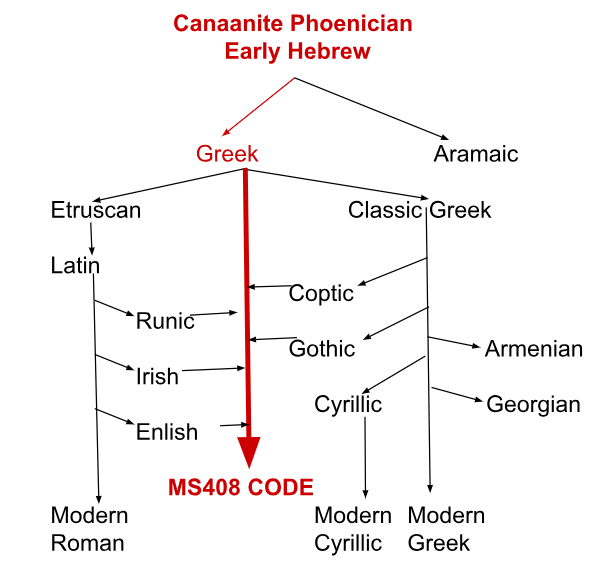
The concept throughout Yale MS 408 the authors employ is the use of dictionary definitions to its entirety. The concept of the alphabet from any English dictionary defines every character attribute and symbol in MS 408. So, to define and set the character set in MS 408 the authors used all known understandings of the word alphabet. What is an alphabet? An Alphabet: alpha and beta. To understand the MS 408 alphabet one must analyze the word “alphabet” and the word “letter”. Coming from Middle English “alphabete” is borrowed from the Ancient Greek alphábētos, deriving from the first two letters of the Greek alphabet system, A 𐤀 and b 𐤁. Pay close attention to the Greek symbols for a and b and how over time they got flipped and turned around. The authors of MS 408 employed this technique to hide the alphabet and its origin point. The concept of the letters and cipher in MS 408 stem from the alpha/beta source understanding, which are:
- A set of letters used to write in a language
- A writing system in which letters represent phonemes. An indivisible unit of sound in a given language. A phoneme is an abstraction of the physical speech sounds (phones) and may encompass several different phones.
- The simplest rudiments; elements. To ground
- One of the simplest or essential parts or principles of which anything consists, or upon which the constitution or fundamental powers of anything are based.
- (chemistry) Any one of the simplest chemical substances that cannot be decomposed in a chemical reaction or by any chemical means and made up of atoms all having the same number of protons.
- One of the four basic building blocks of matter in theories of ancient philosophers and alchemists: water, earth, fire, and air.
- (law) A required aspect or component of a cause of action.
- (set theory) One of the objects in a set.
- A small part of the whole.
- (obsolete) The sky.
- (plural only, with “the”) Atmospheric forces such as strong winds and rains.
- A place or state of being that an individual or object is best suited to.
- (Christianity, usually in the plural) The bread and wine taken at Holy Communion.
- A group of people within a larger group having a particular common characteristic
- One of the simplest or essential parts or principles of which anything consists, or upon which the constitution or fundamental powers of anything are based.
You can not see another individual’s thoughts or ideas until they write them down on paper using letters. Letters written down represent an invisible energy that lives inside your mind, (much like a globe.) Letters are a linear 2D representation of a more complex 3D thought and idea in written form. All around the globe there are many different forms of letters, alphabet systems, and the most ancient form the ideogram. How humans communicate knowledge is based on perception of nature where one’s viewpoint can dramatically change in different cultural regions.
Based on one’s vantage point the cipher characters in MS 408 can mislead the viewer to only see their biased regional perception. Perception is like a mirage and the genius of the cipher. Perception is a magic trick based on your own mind’s perceptual illusion, your mind will see what it wants to see and what it understands. Only with the key to the cipher, which is in the Catalan Atlas, will the “sphere” (cipher) lock into place.
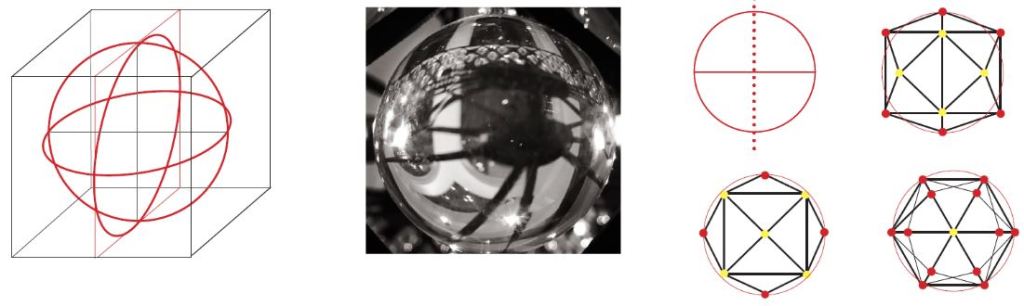
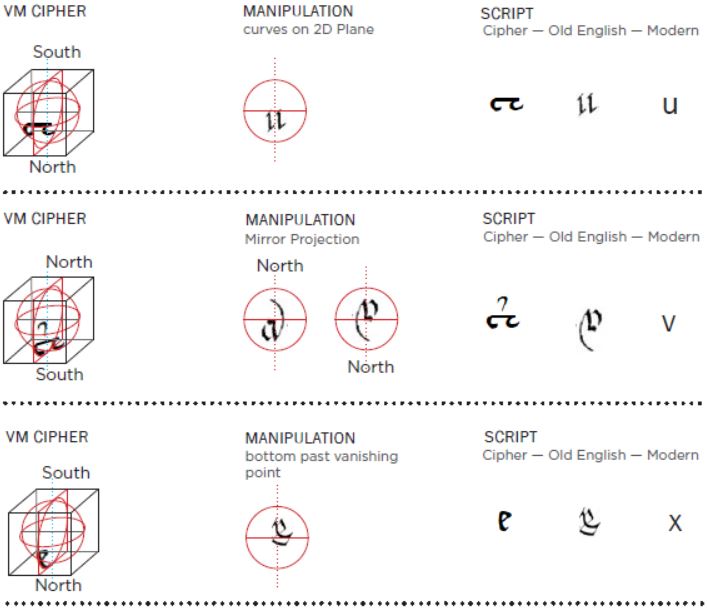
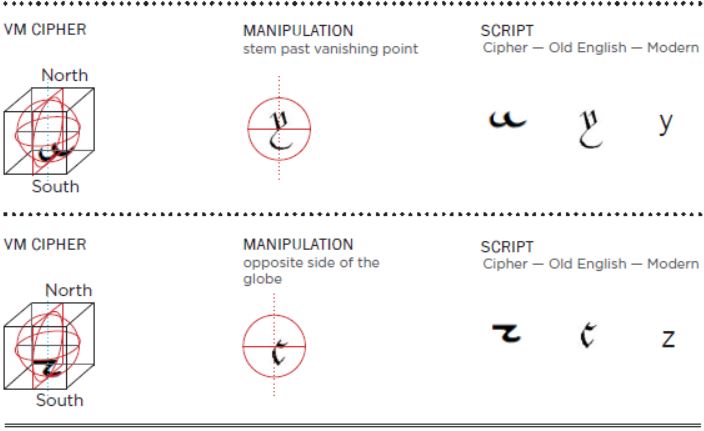
One day, I was at the bank with thoughts of MS 408 on my mind trying to figure out the cipher. I glanced over at the counter where the bank had a crystal plaque award. As I moved, the letters inside the crystal would also move, parts of the letters would disappear, some would flip upside down, some would double on top of each other etc. My vantage point and perception of letters would alter the image. That is how the letters in the the MS 408 cipher work, it is an alphabet system that represents a crystal globe that spins on an axis. The MS 408 cipher symbols live inside a crystal globe and represent 2D linguistic maps of a 3D phoneme sound.
The MS 408 cipher is a fascinating experiment on human perception and perspective of letters, numbers, and math symbols. Without understanding the key, the MS 408 can function in any language by at least 30%. When running tests on different alphabet systems an interesting phenomenon presented itself, multiple “i’s”. The “i”, the eyeball, what you see and observe is vital to the MS 408. There are three cipher symbols that function like an i as well as a j (
In the research and analysis of the writing style of Geoffrey Chaucer, MS 408 characters and it’s illusion started to present itself, (all except the i’s.) By placing the MS 408 characters next to Chaucer’s handwriting script we call today “Chaucer script”, it became obvious what the illusion of the script is stereographic projection: defined by Wikipedia as “In mathematics, a stereographic projection is a perspective projection of the sphere, through a specific point on the sphere (the pole or center of projection), onto a plane (the projection plane) perpendicular to the diameter through the point. It is a smooth, bijective function from the entire sphere except the center of projection to the entire plane. It maps circles on the sphere to circles or lines on the plane, and is conformal, meaning that it preserves angles at which curves meet and thus locally approximately preserves shapes. It is neither isometric (distance preserving) nor equiareal (area preserving).
The stereographic projection gives a way to represent a sphere by a plane. The metric induced by the inverse stereographic projection from the plane to the sphere defines a geodesic distance between points in the plane equal to the spherical distance between the spherical points they represent. A two-dimensional coordinate system on the stereographic plane is an alternative setting for spherical analytic geometry instead of spherical polar coordinates or three-dimensional cartesian coordinates.”

With further research on handwriting systems it was identified that Old English Law handwriting and it’s many different forms was the original script to MS 408. The stereographic perspective of how the cipher works is based on how cartographers were trying to draw world maps in a 2D plane, even today there are many debates and systems used to draw Earth. It was this perspective that the understanding that “i” was always an “i” but had multiple script definitions, and that “y” can function as an “i” and a “y” and are interchangeable in Middle English phonetic spelling scribe traditions. The cursive “i” plays the role of a surveyors tie
The cipher signature Mark
The concept of a signature in the dictionary is the calling sign of House Lancaster’s code mark in MS 408. In analyzing all known alphabet systems and writing script no language matches MS 408 completely. All except King’s and Queen’s from House Lancaster.
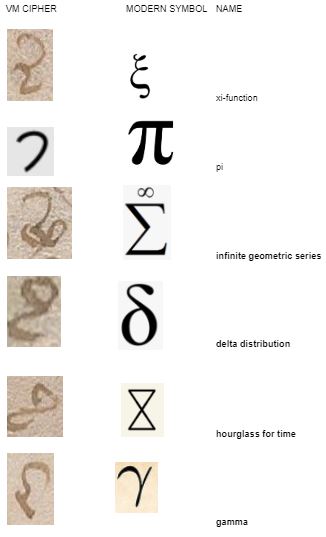
What’s in a Signature? The authors of Yale MS 408 use House Lancaster signature as a mark to signify approval of the document and a stamp in their coins. The signature of the author is scattered throughout the manuscript in fractions as well as their coinage. When connecting the fractions together they produce not only individual names but an entire family and court of names. In cryptography a signature is a message that guarantees that the message originated from its claimed source. England at the time was trying to establish international trade, to do so, they had to stamp official marks in their coins. Those marks are in MS408. This cryptography signature and implications is the mark of King Henry V. The signature of King Henry V itself is a mathematical geodesy called a tuple, defined as a row of mathematical objects. These objects are used throughout MS 408 as mathematical symbols for geodesy equations. Our team believes that MS 408 was created by King Henry V and his Royal court to defend its country against the black plague and create an open international trade system. Below is the dictionary terms of the word signature:
- A person’s name, written by that person, used as identification or to signify approval of accompanying material, such as a legal contract.
- An act of signing one’s name; an act of producing a signature.
- (medicine) The part of a doctor’s prescription containing directions for the patient.
- (music) Signs on the stave indicating key and tempo, composed of the key signature and the time signature.
- (cryptography) Data attached to a message that guarantees that the message originated from its claimed source.
- (figurative) A mark or sign of implication.
- (mathematics) A tuple specifying the sign of coefficients in any diagonal form of a quadratic form.
- (medicine, obsolete) A resemblance between the external character of a disease and those of some physical agent, for instance, that existing between the red skin of scarlet fever and a red cloth; supposed to indicate this agent in the treatment of the disease.
RESULTS
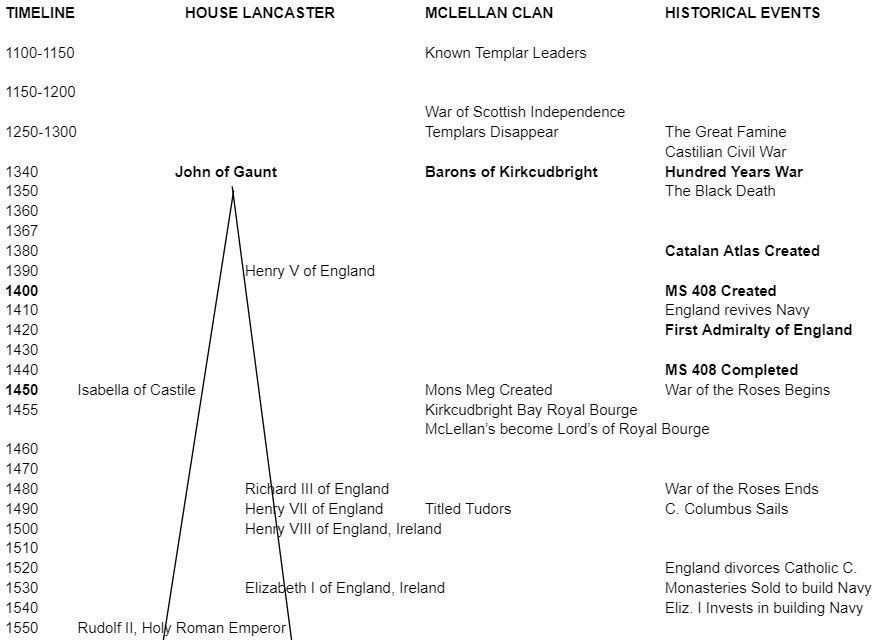
With our recent analysis of identifying House Lancaster as the 15th century origin point; our team explored signatures of House Lancaster, from John of Gaunt to its owner in the 16th Century Rudolf II, Holy Roman Emperor. Over time House Lancaster would split between England and Portugal, by observing which signatures bore similarities to symbols in MS 408 we can start to see a clearer picture of who owned it, why and what they where capable of accomplishing with it.
On the following page is a timeline of House Lancaster members whose signatures contain MS 408 symbols; Clan McLellan significant events; and important events that might’ve been influenced by MS408.

EVOLUTION OF THE ALPHABET INTO MS408 CIPHER
MS408 CIPHER ENCRYPTION AND STEREOGRAPHIC PERSPECTIVE
Cipher exists inside a 3D Globe – displayed on a 2D Plane


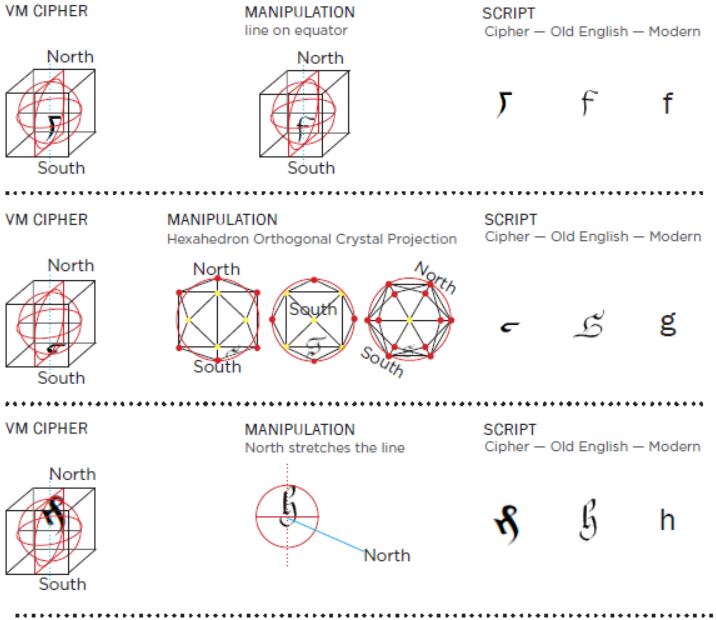

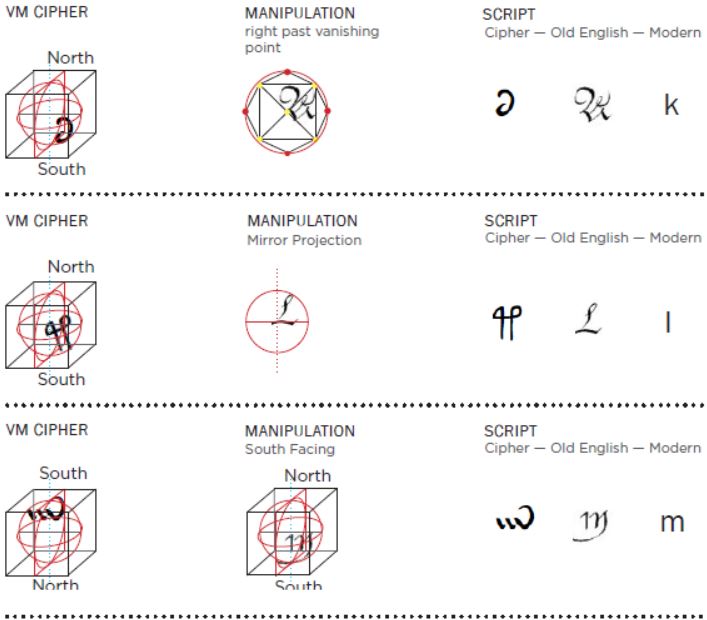

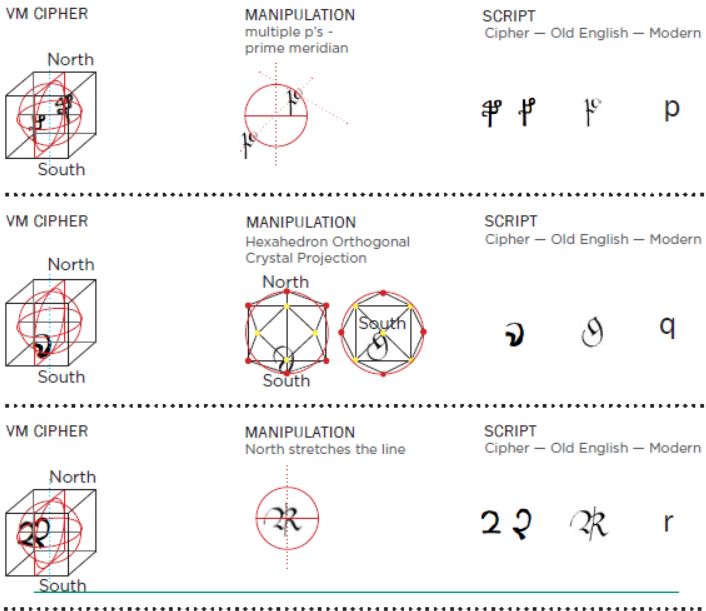
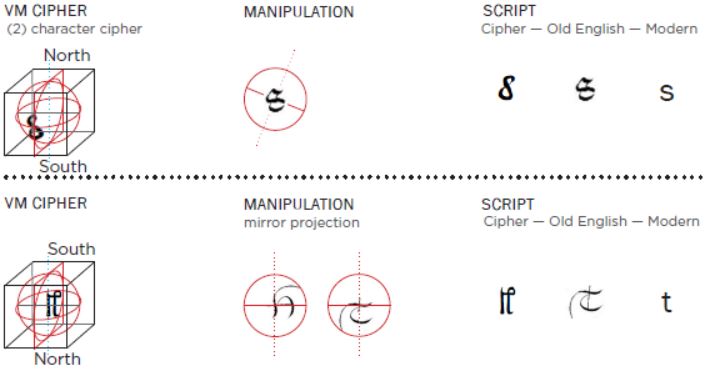
MS408 CIPHER ENCRYPTION OF MATHEMATICAL SYMBOLS
CONCLUSION
During the early 15th century MS408 was being drafted by soon to be King Henry V. In his ship-ryal gold coin he sits a top a Man-of-War ship designed by Portuguese in early 15th century. This ship was designed specifically for long travel capable of sailing around the world. Maps of MS 408 span the entire globe. As King Henry V’s coin states “but he, passing through the midst of them, went his own way.” Over the next hundred years the English would create one of the greatest navy forces that would defeat the Armada. It is not only possible that the English had the Periplus and remade into what we call MS408 but highly likely; characters from Greek to Middle English; symbolism used by English royal monarchs only; and an argot language designed after the Scottish Royal court Galwegian.
 Tucker STEM Team
One thought on “House Lancaster’s Secret Code”