Captain’s Blog: 8/19/2024
The following information was first published in the book “the lost language of Braveheart & Robert De Bruce King of Scots,” by Katie May Tucker and Dr. Wayne R. Tucker 1st edition copyright 2022, ISBN: 978-1-6781-8173-4. Additional information since the publication date had been added and follows international copyright laws.
excerpt from the lost language of Braveheart & King of Scots
Section 4: Key to the Cipher the Catalan Atlas
4.1 ANALYSIS
The key to the cipher of the VM was placed inside the Catalan Atlas, in the analysis of the attributes of the atlas and its map loci, its “origin” point(s), or zero set point of the cipher was discovered. This discovery was made after Phase III online test group was completed, it allowed for the necessary modifications to the alphabet system and base language. The language frequency was compared to the Catalan Atlas “key” and matched.
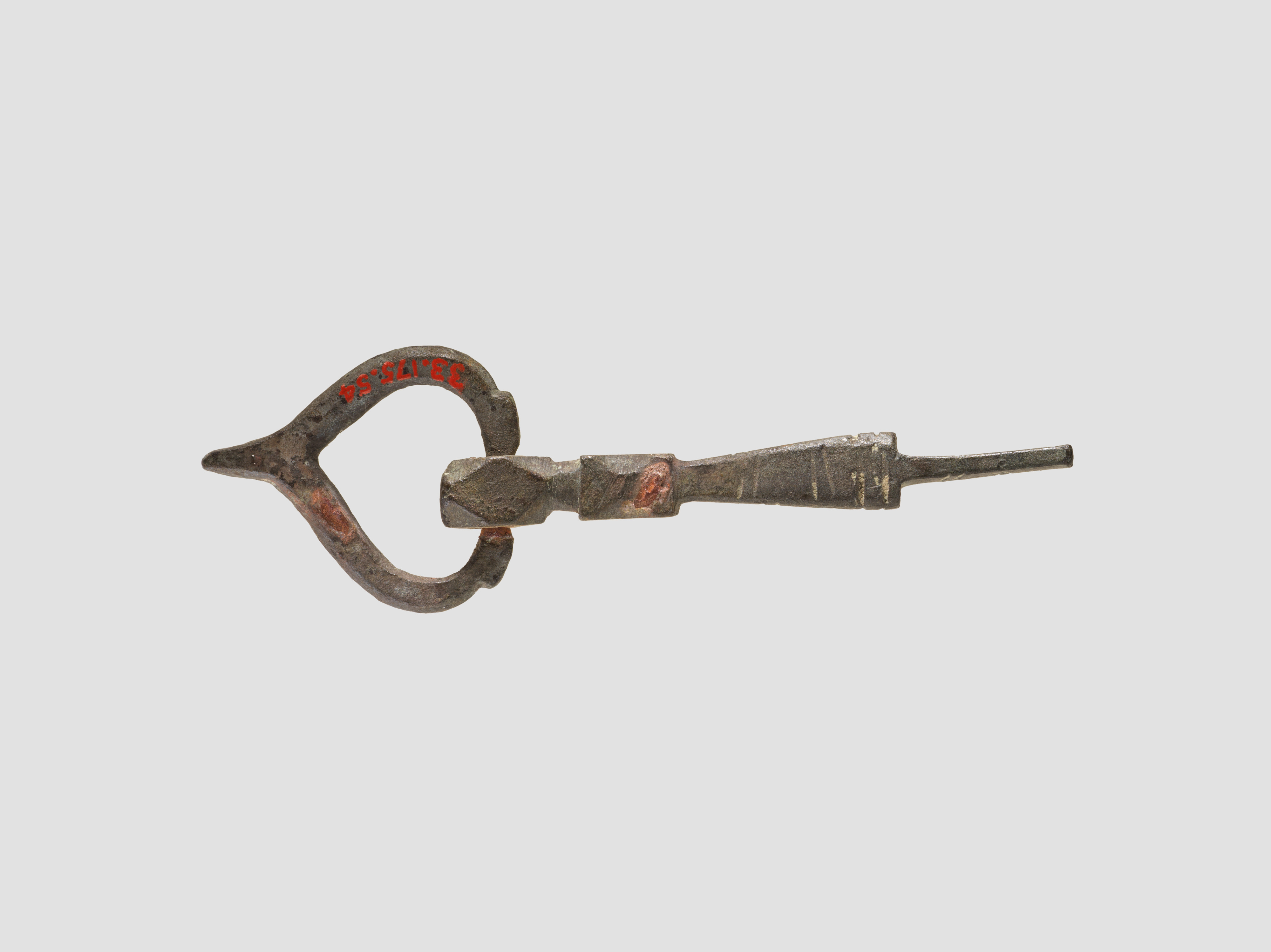
The linguist(s) that created the VM most often used all meanings of a word, even its meanings from its origin, this creates a larger all encompassing definition. For instance, the word key comes from Old English as well as Scots “key, solution, experiment.” The origin is uncertain but it is thought to come from Proto-Germanic “stake, post, pole”. Medieval keys were long poles that were “crooked, bent or twisted.” As previously mentioned, the Catalan Atlas zero longitude point comes from calculating the ellipsoidal shape of earth – this calculation is called a rhumb line. A rhumb line of the Catalan Atlas is the key to the solution; its curved lines, twists, bends through all latitude lines towards true north.
The key to the VM is based on the following definition of the word “key” from Old English “key, solution, experiment.”):
Noun
•The key in the Catalan Atlas was designed to open Europe to the “otherwordly place.”
•The key in the Catalan Atlas was designed to fit between two other objects (Prime Meridian points of a map rhumb line) to maintain their relative orientation.
•The key is a crucial step or requirement to the voyage in the VM and all voyages to this day.
•(figuratively) The general pitch or tone of the VM is from the region that the Catalan Atlas key is located; also, the context of the Catalan Atlas and VM are the same – International Maritime Trade.
•(botany) An indehiscent, one-seeded fruit furnished with a wing, such as the fruit of the ash and maple; a samara. Used figuratively the Oak/Elm Trees from Oak Island is the starting point (surveyors bearing tree) and monetary foundation to the VM.
•(cryptography) A piece of information (e.g. a passphrase) used to encode or decode a message or messages. Without the Catalan Atlas you can not decode the VM.
•(masonry) A keystone. The VM law is the foundation in which Modern Society was built.
Adjective
•Indispensable, supremely important.
•Important, salient.
•Worthy of note; pertinent or relevant.
•Prominent; conspicuous.
•(heraldry, usually of a quadruped) Depicted in a leaping posture.
•(often military) Projecting outwards, pointing outwards.
•(obsolete) Moving by leaps or springs; jumping.
•(obsolete) Shooting or springing out; projecting.
•(geometry) Denoting any angle less than two right angles.
Verb (The Voynich Manuscript was made to:)
•To fit (adjust) trade routes
•To fit (in agreement) with international merchants in alliance between them.
•to carry a mark (marquee) to indicate with a symbol they are a member in the alliance
•To link (as one might do with a key or legend).
•To attune to create peace and harmony to the world.
•To fasten or secure firmly with members in the group.
(side note: and lets not forget it also references the Chinese word chi pronounced “key” meaning energy force.)
4.2 RESULTS
4.2.1 CATALAN ATLAS OVERVIEW
The Catalan Atlas is just as mysterious as the VM itself, no one knows for sure who created it. It is believed to have been created in 1375 and was placed in the Royal Library of France by 1380 during King Charles V reign. The map legends were written in Catalan and hide truths by combining riddles, mythology and legends together. The Catalan Atlas contains: an atlas of the world known to the general public; the first rose compass, cosmography, astronomy, Middle Ages calculator, and astrology. The math systems where the first of its day and age and have various symbols associated with navigational bearings, which have been identified in the Voynich Manuscript.
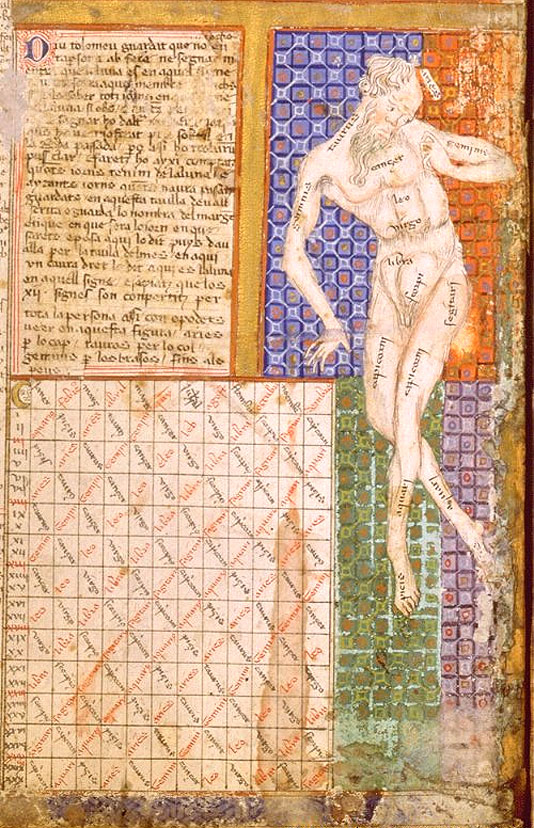
After reviewing the Catalan Atlas text to what has been previously labeled the “zodiac man” it would suggest blood-letting rituals, though in connection to the VM they are riddles that coincide to information in the VM text. The Catalan Atlas reads “Ptolemy says: Beware of touching your body with iron or letting blood so long as the moon stands in the sign that is given on the relevant part of the body. If you wish to know in which sign the moon stands when you need a surgical intervention, blood-letting, or anything of the kind refer to what we have indicated in the previous “wheel.” … And know that the 12 signs are scattered over the whole of the body as you can see on the picture. Aries on the head. Taurus on the neck. Gemini on the arms, and so on down to the feet.”
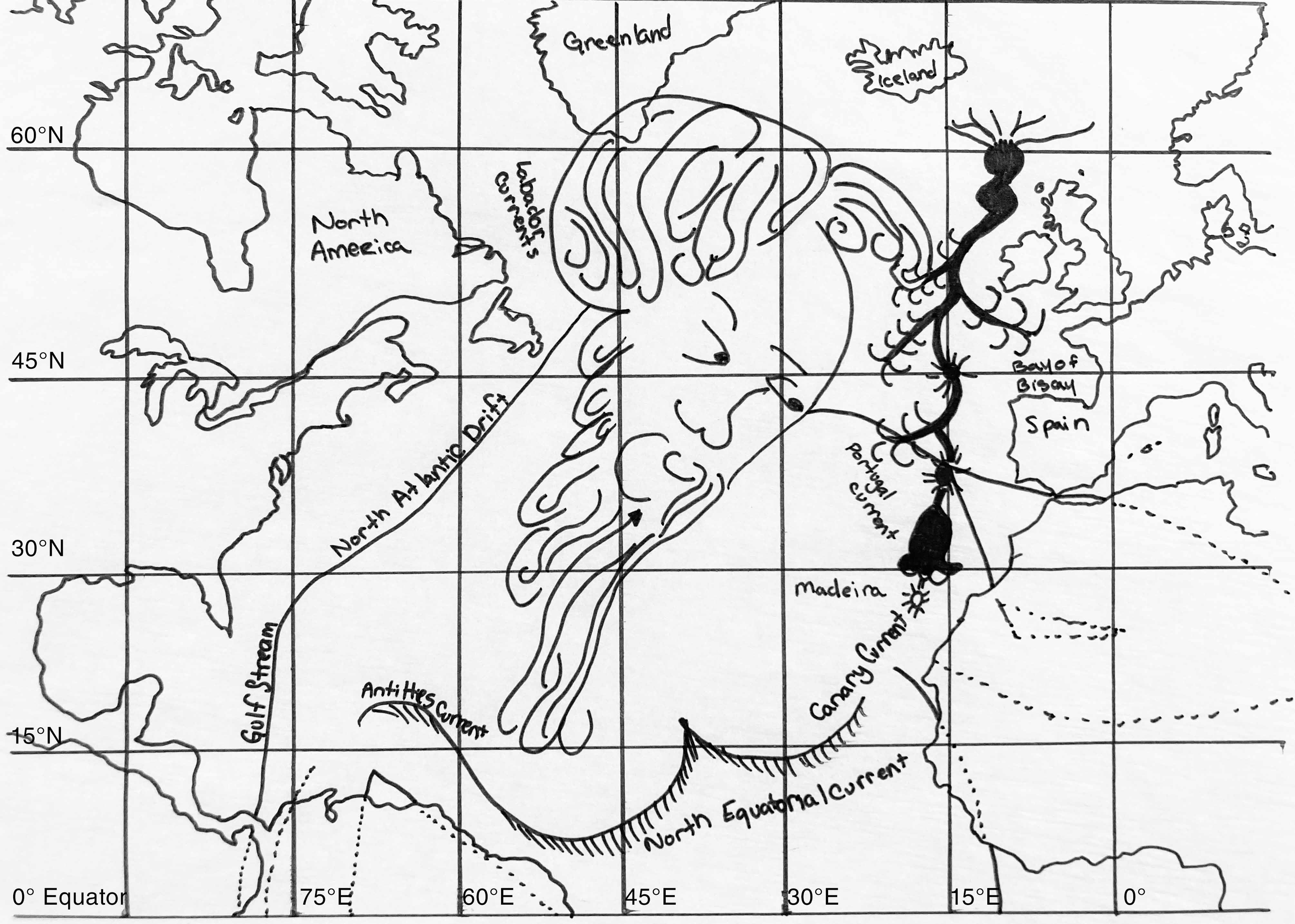
After reviewing The Zodiac Man in other 14th century documents, the man in the Catalan Atlas does not bear the same attributes. We identified him as the Greek God “Poseidon” god of the sea. Each zodiac sign on the body represent ocean currents. Poseidon from the Catalan Atlas is used in the VM text and sets up the map grid of the Atlantic Ocean.
4.2.2 THE ROSE COMPASS
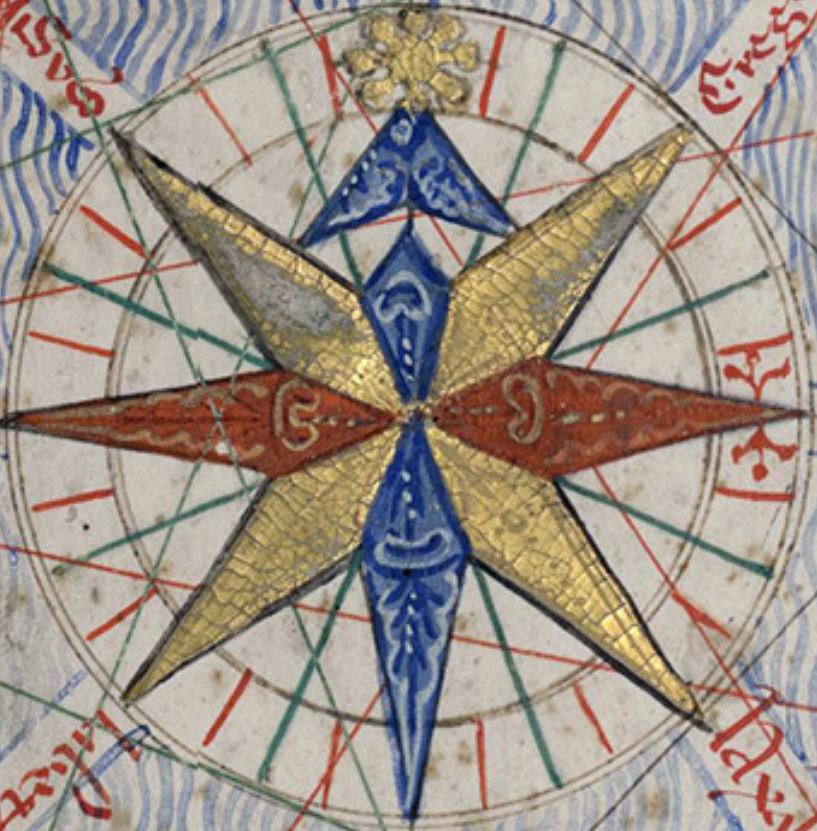
The first appearance of a Rose Compass was drawn in the Catalan Atlas. A compass rose aka. rose of the winds) is a representation of the cardinal directions: north, south, east and west. In Anthropological Linguistics, Vol. 25 “Where do Cardinal Directions Come From?” by C.H. Brown states that cardinal directions were usually derived from either locally specific geographic features (“towards the highlands,” or “towards Scotland,”) or they were from celestial bodies, the sun, the winds, or temperature.
In Scottish culture the meaning behind flowers symbolize a specific person/ clan from a region. When referencing a specific flower it indicates to the Scots cardinal direction as well as a group of people in that direction. The full extent of what flowers meant to the Scots still remains a mystery. During the course of this study we reached out to Kirkcudbright Bay Historical Society that confirmed the importance of identifying people/clans and regions by flowers. However, during the publication of our research the society was still in the process of their own research on the cultural significance of
flowers to Scotland, which once published may further our understandings in this
work.
The VM uses the Scottish symbolism of flowers to indicate cardinal direction in order to hide the true meaning that the flowers where maps. Within the flowers are navigational markings employing Old English property law standards, Old Norse ruins symbolism and Scottish cardinal direction. The flowers in the VM represent more than just where to go next; the leaves could indicate wind speed, or the ships masts, ocean currents, tides, time etc. Each map in the VM is unique to the specific geographic location it represents, which will be discussed in section 6 alongside each folio translation.
4.2.3 CATALAN ATLAS COMPARATIVE ANALYSIS TO VOYNICH MANUSCRIPT
The following are examples of how artwork in the VM and the Catalan Atlas Compare.
•Folio 3r: use of the Catalan Atlas loci points and map. (see maps in previous blog post)
•Folio 3v: use of the Catalan Atlas loci points and map.
•Folio 4r: use of the Catalan Atlas loci points and map.
•Folio 4v: Use of “Zodiac Man” Grid aka Poseidon
•Folio 5r: Madeira Island was supposedly not discovered until 1419, but is accurately mapped in the Catalan Atlas 1375 and in MS 408 by 1430. Recently archeological evidence shows Vikings inhabited these islands by 700AD.
•Folio 5v: use of the Catalan Atlas loci points and map.
•Folio 6r: use of the Catalan Atlas loci points and map.
•Folio 6v: use of the Catalan Atlas loci points and map.
•Folio 7r: Loci Points and secant arc from Canary Island “Teroerife”
•Folio 7v: use of the Catalan Atlas loci points and map.
•Folio 8r: use of the Catalan Atlas loci points and map.
•Folio 8v: use of the Catalan Atlas loci points and map.
•Folio 11r: The secant arc and wind measurements are drawn into the sails of the ship.
•Folio 18r: Use of the “Zodiac” Poseidon Man Grid
•Folio 24v: Poseidon Grid shift in Atlantic to Prime Meridian.(*)
•Folio 25v: Rose Atlas from the Catalan Atlas
•Folio 29v: Flowers are Polish Church’s in the Catalan Atlas, (pg. 49) depicting Kiev Ukraine longitude.
•Folio 30v: Parson Bird. To confirm channel location, the authors put in an Easter Egg of the Parsons Bird and reference the borders of the known world. Near the 36°E mark of the borders of the Catalan Atlas a parson bird was drawn. The Parsons Bird lives in the Auckland Islands of New Zealand approx. 30° S.
•Folio 34r: Catalan Atlas “Zodiac” Poseidon Man Meridian Grid shift and crosses the equator twice
•Folio 37r: Two naked men diving for pearls in the Indian Ocean is the same position as folio 37r. The Catalan Atlas states “In the Indian Ocean where they are fishermen and very rich islands. The fisherman that descend into the sea say their incantations before diving into the sea and this way they dispel the fish. In the event that they do not say them, the fish devour them, and this has been demonstrated.” Folio 37r has a precision cut in the upper right corner, which is exactly the Catalan Atlas cartographers green line in the Indian Ocean. The folio corrective ligature in the center of the right side is also in the Catalan Atlas cartographers green line in the Gulf of Oman. The folio ligature is in the same position as the gold flag with a red square (the flag for Ilkhanate) is located in the Catalan Atlas.
•Folio 37v: The lower left Folio 37v ligature is in the position of the Catalan Atlas Flag of Diogil. It is said that the Monkey God Hanuman’s birthplace was Hampi, India. The folio ligature, the flag of Diogil and Hampi India are all the same coordinates.
•Folio 40r: At this location the Catalan Atlas has an inscription reading “Island of naked people, where men and women wear a leaf in front and one in back.” However, such an island does not exist. The Catalan Atlas just like the Voynich has riddles. Given our modern world knowledge one could guess the riddle means this is an exposed area and to protect your ship from the back and front.
•Folio 40v: The Riddle of Melusine and geolocation of Melusine in the Catalan Atlas.
•Folio 41r: There is an inscription in this region saying “In the sea of the Indies there are seven thousand five hundred and forty-eight islands whose wonders of gold, silver, spices and precious stones we cannot discuss here.
•Folio 41v: Catalan Atlas used two naked men as the South China Sea Monsoon currents with an inscription saying “These people are savages; they live on raw fish, they drink sea water and go around naked.” Which the author is using a play on words to reference mesoscale eddies in South China Sea Current and not actual people.
•Folio 42r: The crowns of the foreign dignitaries begging for spices in China, which bear the same latitude, have the same flower leaves as depicted in the MS 408 leaves.
•Folio 42v: Text references the Great Wall of China and the edge of the known world drawn in the Catalan Atlas.
•Folio 43r: in between the pillars are fine “wheel grid” nod marks. In the translation, the authors point out a “sister” – which in the Catalan Atlas Catholic Sisters are drawn in this region. When lining both of these up together the nods are off the shore of China just east of Shanghai.
•Folio 75r-77v: use of loci points connected to the Catalan Atlas.
4.2.4 LOCI POINTS
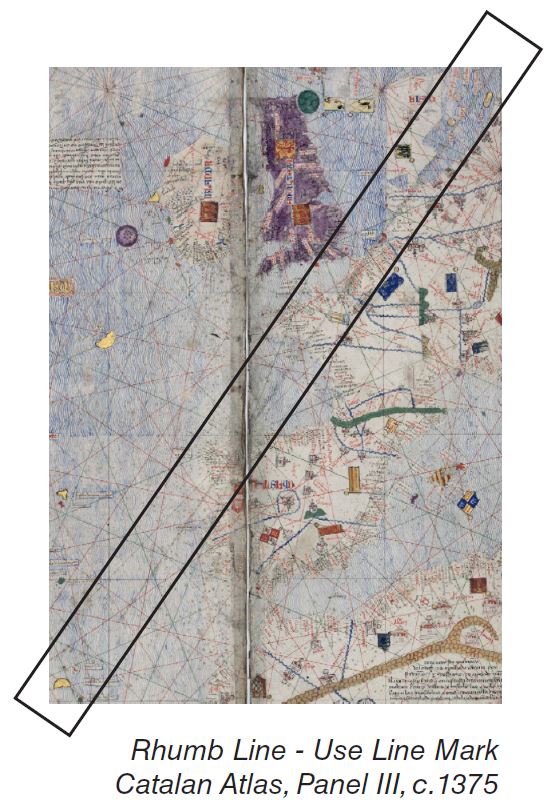
As mentioned in section 4.2.1, The VM used a rhumb line as the key, shown (below). Rhumb lines where not public knowledge until 1537. Maps in the 15th century used a rhumb line as a path with a constant bearing to true north, which is an arc that crosses all meridian longitudes. Upon closer inspection, the Catalan Atlas of 1375 developed the rhumb line using the orb projection system as described in translation of Folio 1r. The mapping projection system is a point-projection perspective based on the mariner’s 48 point compass in 3D. The rhumb line was not a part of the original cartography but was used often enough where the surveyors iron ruler left a watermark in the top corner going towards the middle loci point of Panel III.
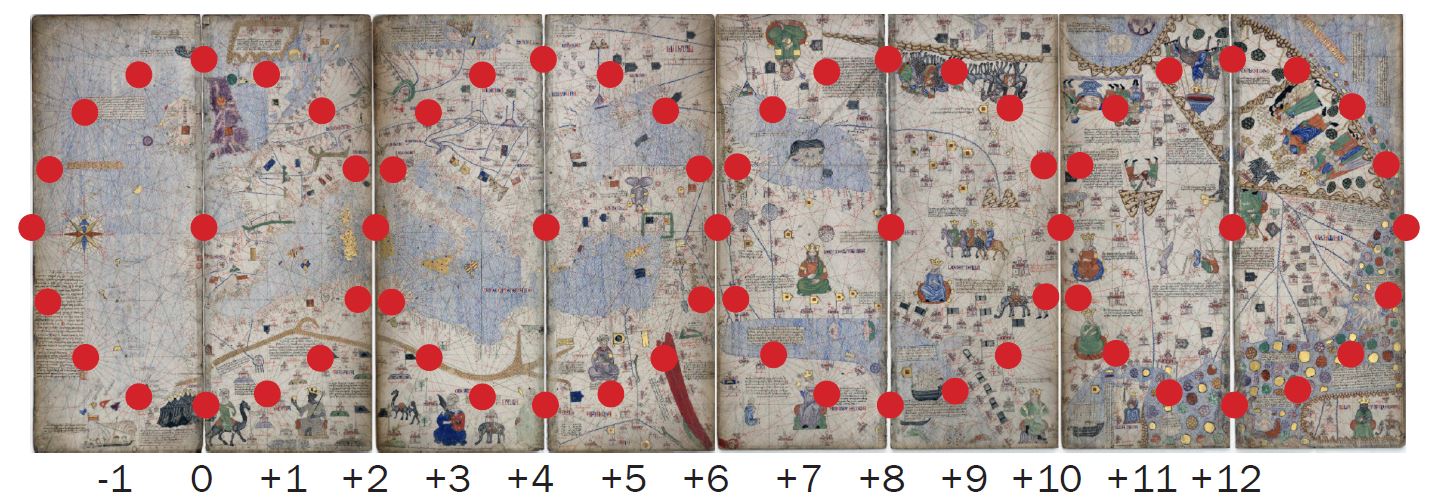
The rhumb line system in conjunction with the Catalan Atlas 48 point compass projection was used as a way to divide time-zones. Though time zones where not publicly used until 1878 the VM references changing time and passing into a different time zone in orientation of the sun based on the following zones. It is similar to modern time zones, however today the zones are divided by country not loci points
4.2.5 MERIDIAN LINE – ZERO LONGITUDE
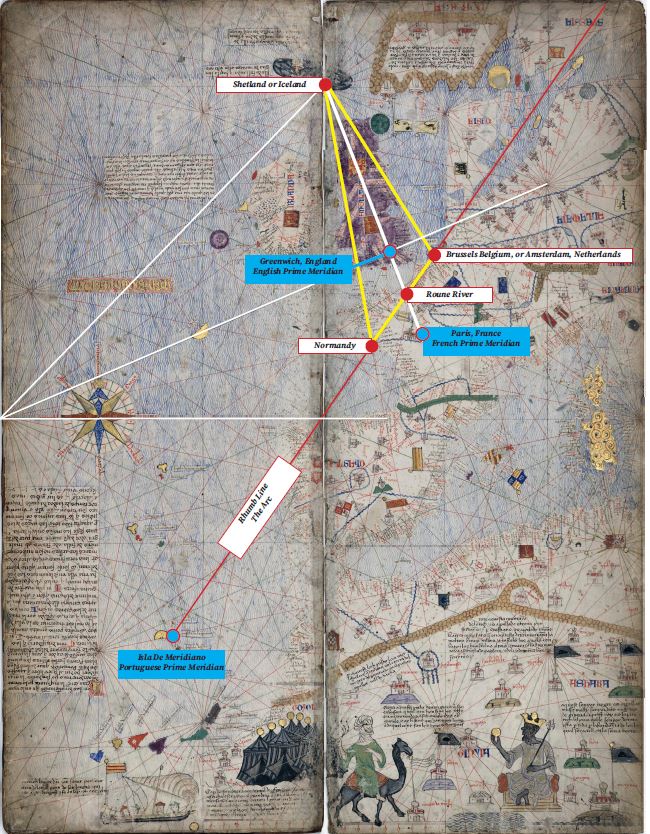
Our discovery of the key in connection to the Prime Meridians was reverse engineered. We first understood the Catalan Atlas, then the cipher, and then discovered how the language functions. It all came together when writing how they work together, we discovered the real key and its connection to the VM and the Catalan Atlas. To engineer the key, the Catalan Atlas used all four prime meridians to draw the rhumb line arc, but on a 2D surface the perspective of the meridian line had to be straight.
The Prime Meridian – zero longitude has been a rivalry since antiquity, there have been various zero longitudinal locations: Paris, France; Greenwich England; Isle of Rhodes; Isle de Meridiano, Canary Islands. But, all these locations are what is needed to unlock the key to the cipher of the VM. The key to the Cipher as shown in the representation by the Catalan Atlas is centered around Greenwich, England and is a representation of Galwegian-Middle English that was spoken within the yellow triangle diagram on the next page. All of these Meridian points where settled by the Vikings as early as 700AD, including the Azores.
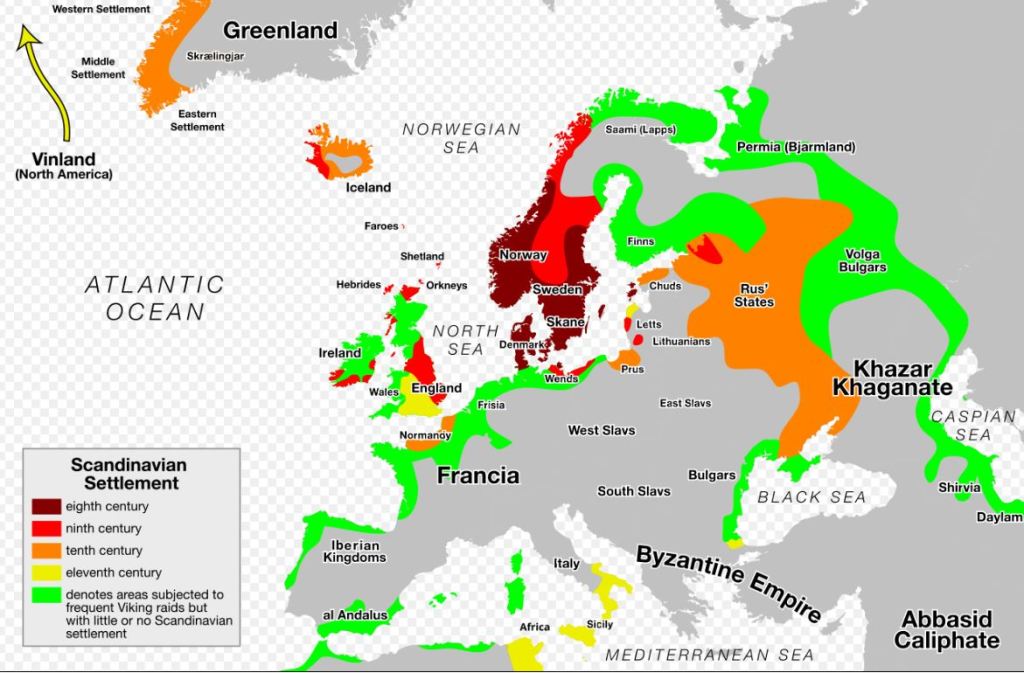
When comparing the key to the Voynich Manuscript to know Viking/Scandinavian Settlements an interesting thing occurs. They match! The language which is discussed in other areas is Galwegian-Middle English, spoken by the royal court of Scotland. The areas that Galwegian was spoken was in the heart of Scandinavian settlements in Scotland by the McLellan clan, known as Spartans, Doric Greeks, Nordic lords, Templars, Tudors and Freemasons. The McLellan Clan apart of the royal court was commissioned to control trade in and out of Scotland for over 600 years. The key to that control was the Voynich Manuscript, or as we call it “The Periplus.”
The map below is Viking/Scandinavian Settlements.
 Tucker STEM Team